Updated
The federal rule: OSHA 1926.51
Federal OSHA 29 CFR 1926.51(c) covers toilets at construction job sites. Its Table D-1 sets the minimum:
| Number of employees | Minimum facilities |
|---|---|
| 20 or fewer | 1 toilet |
| 20 or more | 1 toilet seat and 1 urinal per 40 workers |
| 200 or more | 1 toilet seat and 1 urinal per 50 workers |
Under temporary field conditions, at least one toilet must be available. Where there's no sanitary sewer, chemical toilets, recirculating toilets, combustion toilets or privies are allowed unless local codes say otherwise. The toilet requirements don't apply to mobile crews that have transportation readily available to nearby toilets. Subsection (f) adds washing facilities near work with paints, coatings, herbicides or other contaminants, and lavatories with water, soap and towels or air dryers.
In California, Cal/OSHA's rule is the one to meet
California runs its own occupational safety plan, so job sites here follow Cal/OSHA's Construction Safety Orders. For toilets that's Title 8 §1526, and it asks for more than the federal table:
- at least one separate toilet facility for each 20 employees or fraction of 20, of each sex (a);
- urinals can be part of the count, but toilets must be at least half of the required facilities (a);
- with fewer than five employees, one single-user toilet designated all-gender is enough (a), Exception 1;
- under temporary field conditions, not less than one toilet (b);
- chemical toilets and other non-sewer toilets are allowed where there's no sewer or water supply (c);
- toilets must be kept clean, in good working order, private and stocked with toilet paper (d);
- mobile crews with readily available transportation to nearby toilets are exempt (e).
"Or fraction" means you round up, and "of each sex" means the count is done separately for men and women. A single-user toilet designated all-gender counts toward the total when every single-user toilet on the site is designated that way.
Hand washing: Title 8 §1527
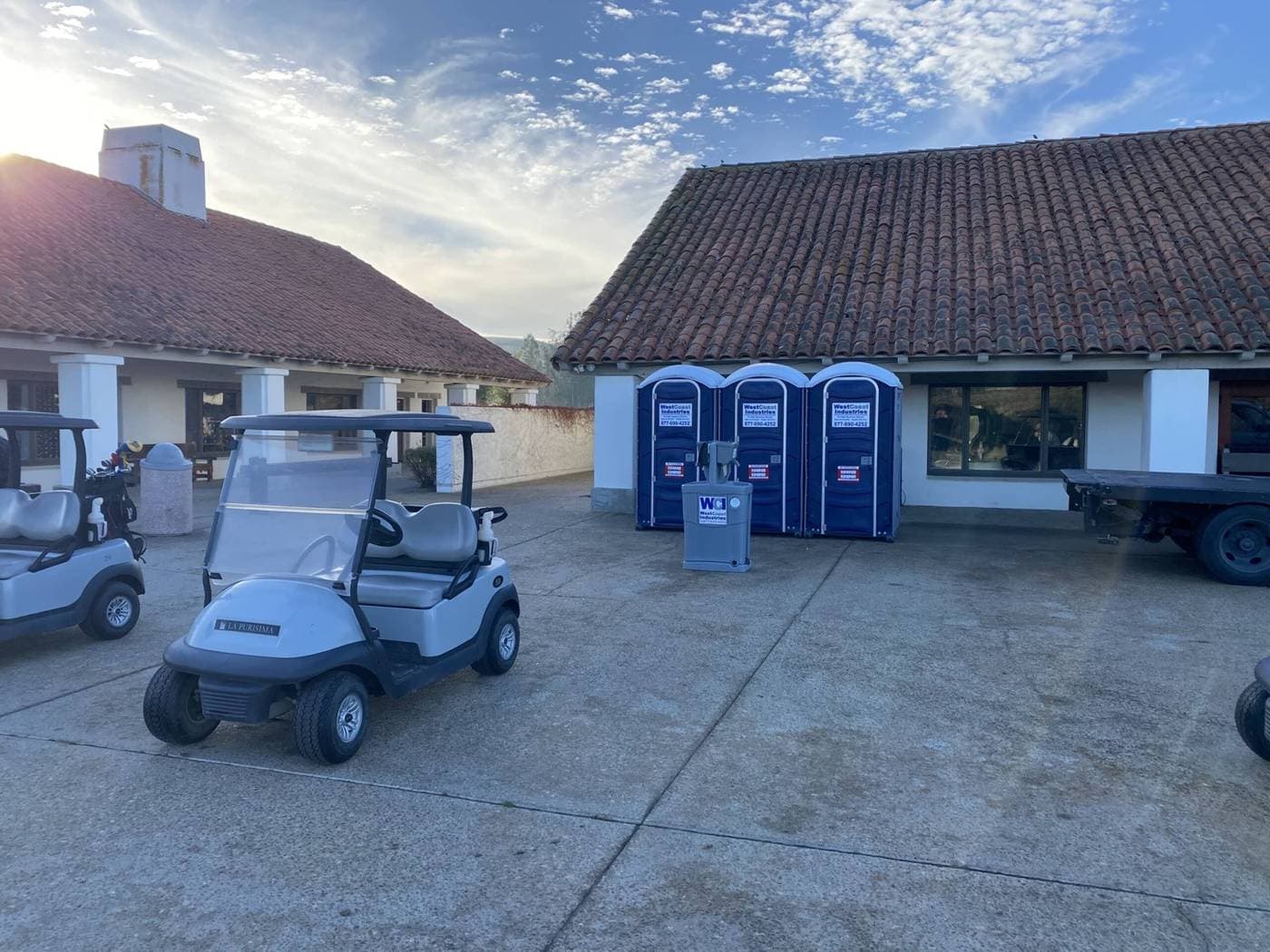
Title 8 §1527(a)(1) asks for at least one washing station for each 20 employees or fraction. Each station must be clean, have enough water, soap and single-use towels or a warm-air blower, and be placed so anyone using a toilet can readily wash. When the toilets are portable (non-sewer), the washing station needs a sign saying the water is for washing and must be outside the toilet, not attached to it. The exception: with fewer than five employees and one toilet, the washing station can be inside it. That's why we pair job-site units with freestanding hand wash stations.
Federal and California side by side
| Crew on site | Federal OSHA 1926.51 | California Title 8 §1526 and §1527 |
|---|---|---|
| 1 to 4 workers | 1 toilet | 1 all-gender single-user toilet and 1 washing station |
| 5 to 20 workers | 1 toilet | 1 toilet per 20 of each sex, and 1 washing station |
| 36 workers: 30 men, 6 women | 1 toilet seat and 1 urinal | 3 toilet facilities (2 for 30 men, 1 for 6 women) and 2 washing stations |
| 80 workers: 70 men, 10 women | 2 toilet seats and 2 urinals | 5 toilet facilities (4 for 70 men, 1 for 10 women) and 4 washing stations |
Do job sites need an ADA unit?
Not for the crew alone. The 2010 ADA Standards, §203.2, exempt portable toilets provided only for construction personnel on a construction site. Many public, commercial and base contracts still ask for one ADA restroom, and any unit the public uses has to meet the ADA. Check your contract; see our ADA guide for the details.
Setting up the site
- Place units near the entrance or where the crew works, on firm, level ground our truck can reach.
- Keep them off the path of heavy equipment and away from trenches and stockpiles.
- Book weekly service for most crews; larger crews or long shifts may need two visits a week. See what weekly service includes.
- For a site office trailer with its own restroom, a holding tank with scheduled pump-outs covers it when there's no sewer.
- Add units when the crew grows, and tell us when trades leave so we can pull extras.
We deliver standard porta potties to sites from our yard in Lompoc to Santa Maria, Santa Barbara and Oxnard. For contractors on Vandenberg, we work with the base's gate and access rules; tell us the gate and contact when you book.
Send the crew size, the start date and the address, and get a quote. We'll suggest the units and set the service day.
Quick answers
How many porta potties does a job site need in California?
Cal/OSHA Title 8 §1526 asks for at least one toilet facility per 20 employees or fraction, counted for each sex, plus one washing station per 20 under §1527. Fewer than five workers can share one all-gender single-user toilet.
Is the federal OSHA table enough in California?
No. California runs its own plan, and Title 8 §1526 is stricter than the federal table in 1926.51, so job sites here should meet the California rule.
Does a construction crew need hand washing?
Yes. Title 8 §1527 asks for one washing station per 20 employees, with soap and single-use towels or a dryer, placed so anyone using a toilet can wash.
Do job sites need an ADA portable toilet?
Units used only by construction workers are exempt under the 2010 ADA Standards §203.2, but many public and commercial contracts require one. Check your contract.
Sources
- OSHA 29 CFR 1926.51, Sanitation (construction)
- California Code of Regulations, Title 8 §1526, Toilets at construction sites
- California Code of Regulations, Title 8 §1527, Washing facilities
- 2010 ADA Standards for Accessible Design, §203.2 (U.S. Access Board)
This guide is general information, not legal advice. Rules change; check the linked regulation and your permit or contract.