Updated
Who the rule covers
Title 8 §3457 applies to agricultural employers: growers, farm labor contractors and anyone who recruits and supervises farm workers or manages the field. The toilet and hand wash requirements in subsection (c)(2) are written for hand-labor operations: hand harvesting, hand weeding, planting, pruning, moving irrigation pipe and packing produce in the field. Field work that isn't hand labor falls under the general sanitation sections (3360 to 3368) instead.
How many toilets and hand wash stations
Subsection (c)(2)(A) asks for separate toilet facilities for each sex for each 20 employees or fraction of 20, and one handwashing facility for each 20 employees or fraction. "Or fraction" means you round up: 21 workers count as two groups of 20, not one.
| Workers on the crew | Toilets (per-20 count) | Hand wash stations |
|---|---|---|
| 1 to 4 | 1 (one all-gender single-user toilet is enough) | 1 |
| 5 to 20 | 1 | 1 |
| 21 to 40 | 2 | 2 |
| 41 to 60 | 3 | 3 |
| 61 to 80 | 4 | 4 |
There are two exceptions on toilets. With fewer than five employees, one single-user toilet designated for all genders is enough. And a single-user toilet designated all-gender counts as one of the required separate facilities when the total number of toilets meets the rule, every single-user toilet is designated all-gender, and any multi-user facilities are split equally between men and women. A standard porta potty is a single-user toilet with a lock, so a crew can label every unit all-gender.
When you can drive workers to the restrooms instead
Exception 3 to (c)(2)(A) lets an employer provide transportation to toilets and hand washing instead of placing them in the field when:
- the field work lasts less than two hours, counting travel to and from the field;
- fewer than five employees at the establishment do hand labor that day; or
- the employees aren't doing hand labor.
A full harvest day doesn't fit any of these, so a crew picking all day needs facilities at the field.
How close: a quarter-mile walk or five minutes
Subsection (c)(2)(D) puts the facilities within a one-quarter mile walk or five minutes, whichever is shorter. On steep or broken ground that takes longer to walk, five minutes comes first. Toilets and hand washing must be close to each other and easy to reach (c)(2)(C). Where the terrain makes that impossible, (c)(2)(E) allows them at the point closest to vehicle access.
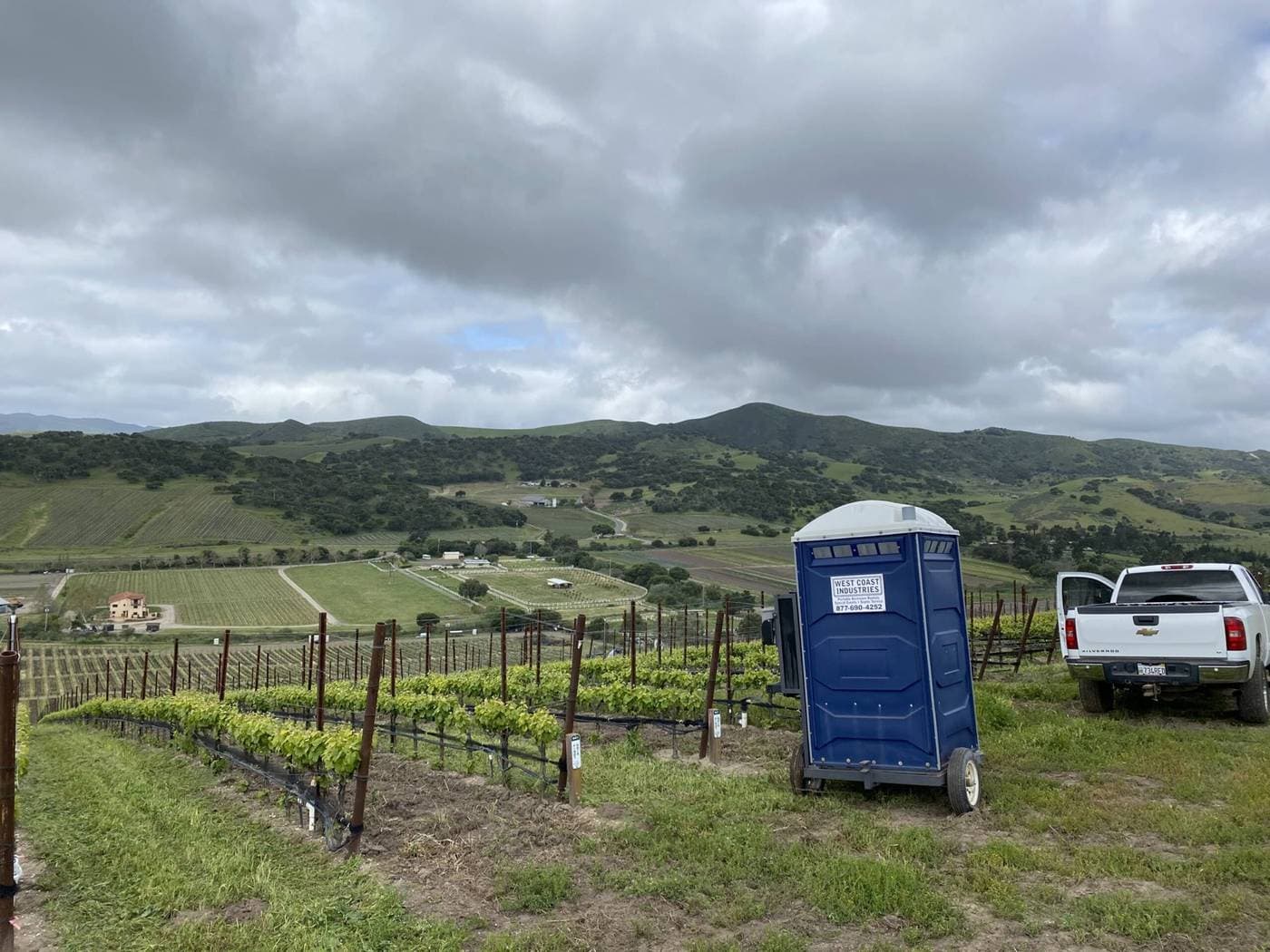
On a large vineyard that usually means the units move as the crew moves from block to block. Tell us how often and we plan the moves with your service. Crews around Santa Maria, Guadalupe, Lompoc and the Sta. Rita Hills, Los Alamos and Paso Robles often have units moved during harvest.
What the units must have
Under (c)(2)(B), toilets and hand wash units must meet these standards at all times:
- screened to keep flies and other pests away from the waste;
- ventilated, with self-closing doors that lock from the inside, and built for privacy;
- at least 8 square feet and 2½ feet wide per toilet seat (10 square feet with a urinal);
- a waste tank of at least 40 gallons on chemical toilets, and at least 15 gallons of water on hand wash units.
Supplies, cleaning and service records
The maintenance standards in (c)(3) are easy to overlook. Toilets must be working, clean, sanitary and in good repair at all times, and the employer must keep written records of service and maintenance for two years (c)(3)(B). Each toilet needs toilet paper in a holder (c)(3)(C), and chemical toilets need odor control and liquefying chemicals (c)(3)(D).
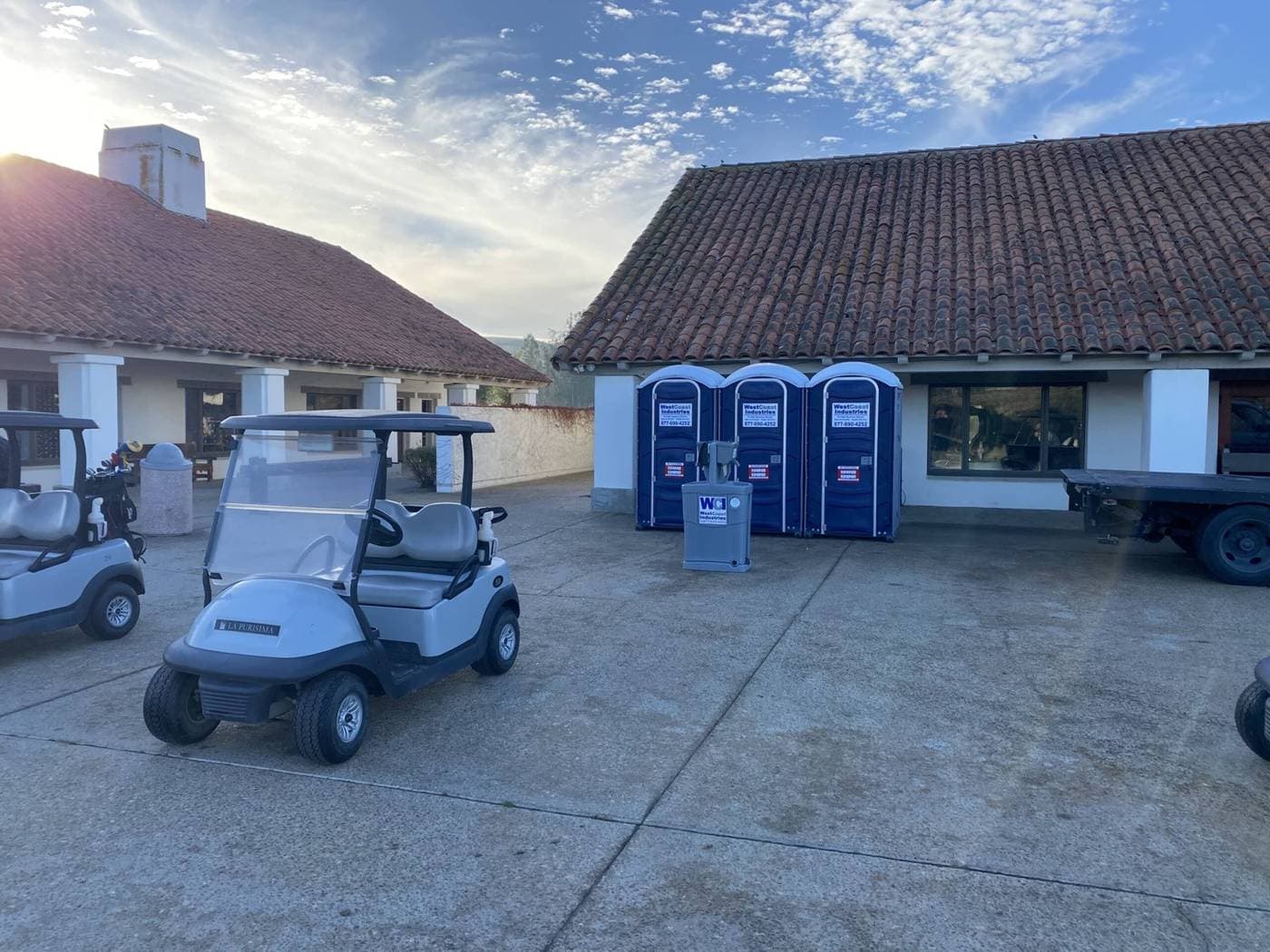
Hand washing needs potable water, refilled as needed, soap and single-use towels, a sign saying the water is for hand washing only, and a spot at the toilet or right next to it (c)(3)(G). Our hand wash stations are freestanding with their own tank and are refilled every time we service the toilets. Ask us for the service records for your units.
Drinking water is a separate requirement (c)(1): potable, cool, in single-use cups or a fountain, available at all times. That one is on the employer; we supply the toilets and hand washing, not drinking water.
Telling the crew
Subsection (c)(4) says the employer must tell every worker where the toilets, hand washing and drinking water are, allow reasonable chances to use them during the day, and explain why it matters: drink water often, urinate as often as needed, wash hands before and after using the toilet, and before eating or smoking. A short talk at the start of the day, in the crew's language, covers it.
Setting it up with us
Send us the peak crew size, the ranch or block locations and the dates. We'll suggest the number of toilets and hand wash stations, place them where the crew starts and set a service day. Ask for a quote for your crew, or read about weekly service. Se habla español.
Quick answers
How many porta potties does a farm crew of 25 need in California?
At one per 20 workers or fraction, 25 workers count as two groups: at least 2 toilets and 2 hand wash stations, with separate facilities for each sex. Labeling single-user units all-gender is how many crews meet that.
How far can the toilets be from the crew?
Within a one-quarter mile walk or five minutes, whichever is shorter (Title 8 §3457(c)(2)(D)). If the terrain makes that impossible, at the point closest to vehicle access.
How long do we keep service records?
Two years. Title 8 §3457(c)(3)(B) asks for written records of service and maintenance kept for two years.
Sources
This guide is general information, not legal advice. Rules change; check the linked regulation and your permit or contract.